Wednesday, 24 April 2013

ON LOOKING GOOD


ON LOOKING GOOD

If you are browsing gems and want to quickly determine whether a clear stone is a diamond or not, there are easy tests you can apply without any special equipment. The popular test of scratching the stone across glass or metal isn't very reliable, and might just give you a damaged gem; instead, looking at the way the stone reflects light or if it fogs up when breathed on, can give you a better indication of whether or not it's a real diamond.

These tests rule out recognizable imposters because the tests rely on the way a real diamond refracts light, conducts heat, and looks up-close. Are there any tests to determine if people are authentic or not? Are they the same inside as they are seen outside? 

As far as a lay person is concerned, I do not think so. When a buyer gets a fake diamond and realizes that fact at some point of time, he/she is genuinely put to distress and the seller is whistling with happiness. However as far as people are concerned fakeness or in-authenticity genuinely harms the seller, by virtue of stress, depression and a total loss of the state of joyfulness.


Most of us have a pitiable need for looking good, and almost none of us are willing to face just how much we care about this need – even to the extent of being silly. And trying to look good to the world around does not look good, and oftentimes it can be seen through .
Just the threat of looking bad, meaning irrational, or being found wrong  or naive or silly (or something against whatever image we have made for ourselves), for most of us destroys even the possibility of “Being Authentic” or to put it simply "to be on the outside what we are on the inside."


The need to avoid the embarrassment or humiliation, which we imagine to be the result of looking bad to people, leaves us defensive, justifying all the time or petulant and bad tempered.  Unfortunately we behave in this manner at the cost of genuine joyfulness, a state which we were born in.


Delving a bit further into this “Looking Good” we will look at the way in which we perceive our world and our built in frames of reference.


Our Perception of the world (or how we see, feel and interpret the world around us)                                                           
The way we look at our world refers to our own thoughts, beliefs, biases, prejudicial religious, social and cultural bindings, and assumptions. These are through which we as individuals interpret and interact with the world, other people, and with our own selves. Everything in one's world is seen through the lens of one's developed perceptions. In fact what we see through these glasses is the reality for us for one's being. Through this lens is the way the world, others and oneself exist for us and this reality is thus inhibited and molded by our perceptions of the world around us. Therefore going by the same thought and looking at other people, their own perceived realities will be different than yours. If we look at this simplistically, it can be traced to our learned behavior and nature. This View of our World is formed through our experiences and people around us from child hood to date. These experiences could be attributed first to our parents, siblings, baby sitters, our nanny, may be grandparents if around us, there after school teachers, friends, peer groups and so on. Till one fine day, maybe after maturity, we develop a certain world view. 

What exactly is 'perception ' .
I will give here, a summary of what is described about perception classically in various books and fora to understand this term easily.

(a)   Our perception of something determines how  we relate to that  thing.
(b)   Perception decides our behavior in relating. To change behavior perceptions requires to  be changed.
(c)   Behaviour in addition to action includes thinking and feeling.
(d)  Change in perception can lead to a change in action, feeling  and  thinking.  
(e)  Two persons generally do not see the same  thing in the same way.
(f)  Perceptions differ due to different data inputs of the same thing.
(g)  Differences in processing the data. ( Depends upon our learned behaviour and nature)
(h)  Reconciliation can occur by sharing of data and own way of looking at it. 
(j)  It is a subjective experience of something hence there is  no right or wrong nor can we correct our perception.


      “Our Perceptions build maps in our heads: What things are or realities. What things should be – Our values. We interpret everything we experience through these mental maps without questioning their accuracy” Stephen Covey.


How our mind works (in my opinion). 
You see that whatever we experience are all thoughts.They could be from the Past, the Present or the Future. Our nature and learned behavior processes these thoughts which lead to emotions. Emotions are the roots of action.
For the same inputs the output in terms of emotions will vary between different people. Seeing something moving on the road, the thought a snake  in your path on a starry night will result in an emotion of fear in you. May be you will get ready to run based on your basic instinct of fight or flight. Why? because you have perceived it as a snake and also perceive/ have learnt that snakes are dangerous and a bite is mostly the "end". How ever a snake charmer in your place will be delighted to have found a snake. He will rush forward to grab it. To him its a means of lively-hood. A truck comes by and in the headlights you see the moving thing is nothing but a rope moved by the wind. Now what? You will stomp on the rope and go on your way. Why? Because in your learnt data bank, a rope is harmless, just used to tie things up. All a matter of perception, nature and learnt behavior. You never even thought that it could be something else other than a snake. A matter of perception too. Similarly looking good looks good is a matter of perception. Our perceptions on looking good lead us to being in authentic too so also resulting in multiple stresses and  loss of "Joyfulness" 


Though people do not agree with me, I call it a kind of programming or our own operating system (OS) which is our nature and behavior patterns. We can select an operating system for our computers, Windows 7, or Unix or whatever we choose to like. However for our own self, we are running an OS which is not our choice.  To put it in another way: World view could be said as the way we perceive the world, people around us, and our own selves, through our perceptions which are definitely the result of how we grew up, our nature and our behavior patterns. These become our frames of reference. Interestingly someone once said, “If people don’t walk your path, it does not mean that they are on the wrong one”. Now sit back and think, “How many times have you been a victim?” Surprised?


Going further the above paragraph is a part of our thinking mind and may be in conflict with our inner self. To give an example:                                                                                                                                      
We often hear grownups saying “I am afraid of the dark” please walk with me up to the bus stand. On closer investigation one finds, the person used to be locked up as a baby in a dark bathroom as a punishment for the days misdeeds or something similar.  As a grown up, we find that particular fear still persists. Here the inner self tries to tell the thinking mind, that there is nothing to be afraid of the dark, but no, by now there is a communication block between the inner or our true self (sometimes people refer to it as the soul) and the thinking mind. This results in stress and at times can lead to psychosomatic illness too.  

                                                                                                                         
Digressing a little, there is a remedy for this “Mimulus” which is for “fear due to known causes” in Dr. Bach’s flower Remedies. Surprisingly the use of this remedy has changed people totally. Those who had fear of dogs, closed spaces (Lifts), lizards, cockroaches, mice, of heights, of flying and many others.


Our Perceptual Restraint.        
                                                                                                                                     
The myriad of experiences one grows through, may they be religious, cultural, social and many others  jell into ones nature and behavior patterns and finally contribute to our glasses of perceptions as to how the world is (our world view) and then maybe how it should be. One can understand the above as “Perceptual Restraints”. To further explain “Restraints”. If you go to an Indian village, you will often find a bull tethered with a long rope to a stake dug into the ground. Now as far as the bull is concerned, his reality is only a circle, radius of that circle being the length of the rope he is tied by. Since the bull's experience is limited to that circle, the bull is unaware of the rivers, the oceans and the mountains and the world which exists beyond that circle. This is a classic case of a "Perceptual Restraint". The restraint in this case being the length of the rope.

If in the same village a foreigner, a girl, enters wearing shorts, the villagers might stone her, or hand her over to the police for indecency. The villagers cannot accept this clothing because they are experiencing a cultural restraint, although by no means it will be called indecent in her country. People say that when in Rome do as the Romans do. Yes true but that is for different reasons, another story.

Revealing for yourself your perceptual restraints through which you see the world, your true inner self and the public facade you use.  

You must honestly and in an unbiased manner examine for yourself the foundations of your perceptual glasses  and frames of reference through which you perceive as to who you are for yourself, relative to who you are for others. In short expose to yourself consciously, your true inner self and your external facade as exhibited for others. If you do this genuinely you will be shocked. Surprisingly, you will find that this awareness by itself (without further effort) relaxes a whole lot of restraints which shape the way of your being and acting  imposed by your prevailing way of looking at the world and your frames of reference. As a consequence, when you are living your normal life, or being a mother/father, or a wife/husband, or being an executive, or when you are being a leader, these restraints and through them the shaping imposed on your freedom to be and act are relaxed. Saying the same thing from another view point, such awareness increases your available opportunities for being and perceiving, imagining, creating, thinking, planning and acting. This results in a dramatically enhanced capability, capacity and importantly an inner joyfulness for living your normal life, or being a mother/father, or a wife/husband, or being an executive, or when you are being a leader.

                                                                                                                             
Be Authentic 
Being authentic is being and acting coherent with how you look at yourself on the inside and the facade (may call it as pretense) you put up for others on the outside. If these two are not congruent you are being in-authentic. This includes allowing others to hold you or see you or perceive you in a way you are not. The path to genuineness is being authentic about your differences in the way you really are and in the way you put up a facade on the outside. In other words face your in-authentic persona.


Are You Being Authentic?                                                                                                                                    
Most of us think of ourselves as being authentic. However, each of us in certain situations, and in certain ways, is inauthentic, probably all the time. Since we always avoid at all costs facing our in-authenticities, we are consistently in a state of being inauthentic or non genuine, not only with others, but with ourselves as well. The point is, you are inauthentic and you don’t know that you are being inauthentic. This is because over a period of time your facades become a reality for you. That is human nature. It also means that you have started fooling yourself that your facade for others is the real you.  That’s truly foolish and sure as sunrise will result in joylessness at some point not too far off.   

Here is something interesting:  Sartre's novels are perhaps the easiest access to this mode of describing authenticity: they often contain characters and antiheroes who base their actions on external pressures—the pressure to appear to be a certain kind of person, the pressure to adopt a particular mode of living, the pressure to ignore one's own moral and aesthetic objections in order to have a more comfortable existence. His work also includes characters who do not understand their own reasons for acting, or who ignore crucial facts about their own lives in order to avoid uncomfortable truths; Typically, authenticity is seen as a very general concept, not attached to any particular political or aesthetic ideology. This is a necessary aspect of authenticity: because it concerns a person's relation with the world, it cannot be arrived at by simply repeating a set of actions or taking up a set of positions.                        


All of us want to be admired and almost none of us is willing to face how much we want to be admired, and how easily we will fail being straightforward and completely honest in a situation where we perceive doing so threatens us with a loss of admiration. Unfortunately wanting to be admired “at all costs” is a typical learned behavior. We will do anything to be admired and the loss of authenticity seems a small price to pay, especially when you are not even aware that you are being inauthentic or non genuine, even if you did, are unaware that being inauthentic costs you your inner joyfulness and results in stress, depression and a number of psychosomatic ailments.
If we look around us, it is so easy to spot inauthentic people.

The other day I was in meeting with a ops director of a company where I was scheduled to conduct a soft skills development Training Program for workers. To me he says "tune them up so that they cause minimum trouble. I am not concerned about their families and their troubles as long as they give out put". "I am not going to give them a raise, I have put it forward to another point of time". Just a few minutes ago I had heard him addressing workers with big smiles, : "I am very concerned about your well being and of your families, not to worry we are not only here for you but your families too. The company is here because of your efforts, we are only helping you to achieve. About you raise it is under consideration of the board. Etc Etc......" He never realized that he was not being genuine.

Often times I have heard and read, that being authentic is bad for leadership with a whole lot of examples. Every time I have found that the leader is not being genuinely authentic.                                       
I repeat here for those: The point is, you are inauthentic and you don’t know that you are being inauthentic. This is because over a period of time your facades become a reality for you. That is human nature. It also means that you have started fooling yourself that your facade for others is the real you. That’s truly foolish, it may result in you trying to disrupt a team by using the maxim "I am authentic" so I must point out deficiencies in the people of the team, equipment, working processes and a whale of other related issues. While all the time you are acting through your facade and not in congruence with your espoused principles. 

If you don’t recognize being inauthentic when you are and if you are not willing to face that you are being inauthentic, you have no chance of being authentic leading to loss of internal joy of living. So face and examine your in-authenticities. Examine your world view and perceptual restraints, accepting is half the battle won. Change your thinking.                                                                                                                           

Sit in silence (as explained in my blog Comments on the Tao of learning) three times a day. This will help you to find the path of authenticity. It will also open communication between your thinking mind and the inner self, this will definitely help to remove your perceptual restraints. At some point of time (you may or may not realize it), you will become a genuine person, authentic, radiant, and importantly you will experience the joyfulness in your being. Don’t worry you look great already !!!!!!

Ajay

Visit blogadda.com to discover Indian blogs

Monday, 15 April 2013

A COMMENT ON MY BLOG “THE TAO OF FORGIVENESS”


From Here and There
A COMMENT ON MY BLOG “THE TAO OF FORGIVENESS”

"Ajay Kaka is it easy to forgive the ones (near ones/ so called loved ones) who have hurt u the most??? where in it is not the 'inflated' but just the sense of belongingness that is badly scratched? how?"

I am sorry my reply to your question was too long. Therefore it was rejected in reply column. Hence I am putting up a reply as another blog.

My answer would cover three blogs, which I would like you to read carefully.

1. The Tao of Forgiveness. ( On which you have commented)
2. Some thoughts on spiritual growth.
3. Usted Felz, or Are you happy.

Firstly: I would like to get one thing clear. You and you alone are responsible for your state of joyfulness or otherwise. Why do you get the feeling of being hurt? Because in your perception you expected others to behave in a particular way so you would remain joyful. Remember nobody has the power to make you happy or unhappy, you are happy, Your joyfulness depends on you alone. You have to take full responsibility “here and now” for everything you experience, for what you are, what you have and what you do. Because it is your own programming, or your learnt behavior and your nature, that creates your actions on your experiences, so also these actions influence the actions of people around you. Now think why your sense of belongingness was badly scratched? Was your joyfulness slightly overly dependant on your sense of belongingness? Which one would call one of our comfort zones? Putting it simply was your belongingness to a particular family or organization instrumental in making you joyful? 

From your response it was. In essence your sense of belongingness was instrumental in making you joyful! Against our principle “You are happy, Your joyfulness depends on you alone”. So now please learn to love yourself first, to change and get out of your myriad of comfort zones, to understand that nobody has the power to make you joyful “You are joyful within yourself.” Not even your husband, your children or any of your loved near and dear ones. Now read my blog mentioned at 2 &3. Implement. 

If you change your thinking consciously, your emotions will change automatically. Thinking mind you can train and control, emotions are out of your hands, no control, emotions will depend upon your learnt behavior which processes thoughts leading to those particular emotions. Now do you understand your emotion on the experience of your sense of belongingness being badly scratched. Because you thought that your sense of belongingness was important to your joyfulness. In reality your thought should have been: I am happy that I belong, but tomorrow I will still be happy if I don’t belong, after all I have to let go of a particular branch of a tree and alight on others to expand my horizons! Then what would be your emotions? To train your thinking mind I have included a simple system of  THE ART OF DOING NOTHING OR SITTING SILENTLY. Practice this for 20 minutes, 3 times a day, then see the changes in your thinking mind or the Vigyanmaya kosha.

Secondly: The concept of “to forgive”. Please read the blog on which you have commented above carefully. When you attain a state of “I am happy, my joyfulness does not depend on anyone”, then the question of “to forgive” does not arise at all. In the above blog: Reference  'Think of all the people who have done or said something against you in the recent past, especially those who you cannot forgive, scratch a potato for every such person, put it in a sack and carry this sack where ever you go.
The Master says quote  “'Forgiving someone is the equivalent of removing the corresponding potato from the sack. How many of your transgressors are you able to forgive?' 'I've thought about it quite a bit, Master,' the disciple said. 'It required much effort, but I have decided to forgive all of them.' 'Very well, we can remove all the potatoes. Were there any more people who transgressed against you this last week?' 

The disciple thought for a while and admitted there were. Then he felt panic when he realized his empty sack was about to get filled up again. 'Master,' he asked, 'if we continue like this, wouldn't there always be potatoes in the sack week after week?' 'Yes, as long as people speak or act against you in some way, you will always have potatoes.' 'But Master, we can never control what others do. So what good is the Tao in this case?' 'We're not at the realm of the Tao yet. Everything we have talked about so far is the conventional approach to forgiveness. It is the same thing that many philosophies and most religions preach - we must constantly strive to forgive, for it is an important virtue. This is not the Tao because there is no striving in the Tao. ''Then what is the Tao, Master?' 'You can figure it out. If the potatoes are negative feelings, then what is the sack?'
  
 'The sack is... That which allows me to hold on to the negativity. It is something within us that makes us dwell on feeling offended.... Ah, it is my inflated sense of self-importance. 'What will happen if you let go of it?' 'Then... The things that people do or say against me no longer seem like such a major issue.'   'In that case, you won't have any names to inscribe on potatoes. That means no more weight to carry around, and no more bad smells. The Tao of forgiveness is a conscious decision to not just to remove some potatoes... but to relinquish the entire sack. In other words to live in a state of constant forgiveness.
Therefore Jyotsna you cannot keep forgiving people, every day you will perceive somebody doing something against you, that means if your joyfulness depends on others you will be eternally unhappy because your sack of smelling potatoes will always remain full. Time to let go of the sack itself !

   THE ART OF DOING NOTHING OR SITTING SILENTLY

1. This is the art of doing nothing.

2. Can be done very easily by everybody. It does not take up too much time. It is required to be done 3 times a day for 20 minutes at a time.

3. Benefits : Relaxes the body, the brain/intellect and helps to alleviate all kinds of Stresses. This sitting silently allows the body to get rid of stress producing hormones and proteins like Cortisol and DEOH. Plus it also helps in producing Serotonin which is the chemical which makes us feel happy and joyful. Most importantly it gives rest to the mind. Meaning it carries out maintenance of our thinking mind. Further you will find that over a time you will require less sleep at night. Importantly you will train your thinking mind to let go of thoughts ( let thoughts come and go), and not react every time. So in your day to day life you will not react to negative experiences, those are also finally thoughts. These thoughts will come again but now you will not react but respond logically.

4. While sitting silently for 20 minutes we will not focus on 
anything, or on any thoughts. It is simply an art of doing nothing.

5. Remove your belt so that you are comfortable. Remove your glasses. Sit in a straight backed chair your buttocks touching the back of the chair. You must have support for your back.  Ankles crossed. Sit straight. However your head should be slightly bent forward from the neck to attain a comfortable position. Keep your hands in your lap, palms facing upwards, the palm of your right hand sitting in the palm of your left. If the chair has arm rests you may rest your elbows on the rest if you feel comfortable otherwise need not. Now close your eyes. Please tell your family members or friends not to disturb you in any way for 20 minutes. If anything is urgent they must only tap you on the head. You may come out of silence as explained later.

6. Relax your feet and toes, then your ankles, then calf muscles, then your thigh muscles, then your stomach, chest, shoulders, neck, arms, wrists and hands. Sit silently in this state. Let your thoughts come and let them go. Do nothing, do not try to stop your thoughts importantly do not get involved in your thoughts, let them come and let them go. Even sounds or smells from outside are thoughts let them come and let them go. Example a thought comes to you that you have to ring up your boss at 8 o clock about an important client message, now don’t start thinking what will the boss say, can you keep the client happy etc. That is getting involved, let that thought come and let it go. Similarly you hear a motor cycle horn outside don’t get involved in the sound by thinking who must it be now in the morning etc. let it come and let it go. Just do nothing. 

In the beginning there will be hundreds of thoughts coming and going gradually they will reduce and you will have periods without any thoughts. Starting maybe 10-15 secs you will have no thought periods, slowly over the days , weeks, months, years these periods without thoughts will increase. We have to achieve nothing, nothing will happen, do not have expectations as to this will happen or that will happen. Just continue 3 times a day for 20 minutes. If your head bends forward more let it. No problems. But do not let it bend backwards and take support/rest against a wall or something, the moment your head gets support/rests against a wall you might fall asleep. You may fall asleep initially if you are too stressed. Do not worry when you wake up don’t get up suddenly you may feel groggy, continue sitting silently till your 20 minutes are up.

7.  Coming out of silence. Initially you can set your mobile or clock alarm for 20 minutes. After some practice you will automatically know that 20 minutes are up. For coming out of silence, do not open your eyes. Move your hands first, rub your palms against each other, wipe your face with your hands, then wipe your arms and wrists, stretch your hands to the front once or twice. Then slowly blink your eyes 3-4 times, close them again for a few seconds then again open them very slowly. If you feel like sitting sit there for 3-4 minutes before getting up do sit.

8. Conditions. There are’t too many conditions. You must be a little bit hungry and a little bit tired that’s all. Therefore the right times are just before you have breakfast, before lunch and before dinner in the evening. You can practice this type of silence in a train, a bus or anywhere. There are no conditions except you must have some support/rest for your back. People at home or in office may make fun of you, do not worry. In the office you can easily spend 15- 20 minutes of your lunch time for meditating before lunch. It does not take more than 15 minutes to have lunch. This will be time well spent than just gossiping. Others will soon follow you.


  ON CARRYING OUR PERCEIVED BURDENS: A STORY

One day a sage, the leader of a particular religious sect was walking through rural India along with his disciples. The group was enlightening people and generally helping them for the betterment of their lives. This particular sect, part of a religion had very strict rules. One of them was not to even look at women. They were supposed to avoid even a glance. 

As they finished preaching in one village they set out for the next one. On their way in the hot sun at noon, they came to a river. It was very fast flowing and the stones to cross over were under water. On the near bank a very beautiful lady was sitting and crying. So the sage asked her “my dear why are you crying?” The women replied “Sir my baby must be hungry and crying in my house on the other side, I am late from work and I am afraid to cross the river as the stones are underwater”. “I am really worried about my hungry and crying baby. I do not know what to do”. So the sage without a second thought lifted her, slung her on his shoulder, like in a fire mans lift and proceeded to cross the river. On reaching the other side he put her down and the group went on their way. 

By evening the group was on the outskirts of another village. The sage found that one of the disciples was markedly silent, neither conversing with him or others of the group. So he approached him and asked him, “Son are you ill or not in comfort, as I see you have been silent and not conversing with any one for a long time now.” The disciple replied “no Guruji I am fine, there is nothing wrong with me.” So the night was spent in another village and the grouped moved on. 

After 3 days and 3 nights the sage found that the disciple was still silent and most non communicative. So he again approached him and asked the disciple about his welfare. Again he received the same reply, “I am perfectly fine Guruji”. This time the sage insisted that he be open and frank, so also to be forthright and without fear and tell the sage what was troubling the disciple.

Upon hearing the sage, the disciple spoke thus. “Guruji, I have never disobeyed you nor questioned you actions, yet today I am very unhappy. In our faith we are not even supposed to look at women, Yet 3 days ago you carried an extremely beautiful woman in such a way, that you were touching and feeling her most intimate and private parts”. On hearing this, the sage smiling replied thus. “Son, I decided on the spur of the moment to help her, after carrying her across the river and setting her down, in a few minutes I forgot about her, yet here you are, it is now 3 nights and 3 days and you are still carrying that women” So folks let go of your past burdens, your perceived insults,injustices and injuries, start anew burden free and remain joyful. To do this Sitting silently as told above is a good to do thing.


Lastly:  Jyotsana I hope this helps and all the best. Thank you for your comment.

You can use some music to initially help you with sitting silently. It is a 20 minute cut from Ganapati Sachidanand Swami's Celestial Message in his Music for meditation collection. You can down load from here

CHEERS!


Sunday, 24 March 2013

TRAVEL AND HOLIDAY- KAZURI CLAY BEADS FACTORY NAIROBI KENYA


KAZURI BEADS FACTORY

After having spent practically a day at the Anselm Kitengela glass works, my daughter pulled me out the next day to the Kazuri Beads factory. Again I was very surprised at the work which is done there. Highly commendable. This trip was all along the highway so was a very pleasant drive. Here are some interesting facts.
Kazuri Founder - Lady Susan Wood was born (1918) in a mud hut in an African village. Her parents were missionaries from England in the Ituri Forest. Lady Wood was sent back to England to be educated and married Michael Wood, a surgeon. They came to Kenya in 1947. Both were dedicated to making a difference and Lady Wood started a coffee plantation on the Karen Blixen estate (famous from the award winning movie "Out of Africa") , at the foot of the Ngon'g Hills, about 30 minutes from the bustling Nairobi city center in Kenya. Lady Wood was a visionary, an unsung hero of her time. She assisted her husband in founding the East African Flying Doctor Service, which expanded into the African Medical Research Foundation (AMREF) of which Michael Wood was Director General for 29 years. Michael Wood was knighted in 1985.
The beginnings of Kazuri Beads
In 1975, Lady Susan Wood set up a fledging business making beads in a small shed in her back garden. She started by hiring two disadvantaged women, and quickly realized that there were many more women who were in need of job. Thus was Kazuri Beads  created and began its long and successful journey as a help center for the needy women, especially single mothers who had no other source of income. In 1988 Kazuri became a factory and expanded hugely with over 120 women and men. Here women are trained and apply their skills to produce these unique and beautiful beads and jewelry. The beads are made with clay from the Mt Kenya area thus giving them authenticity to their craft. The factory acts as a social gathering with the hum of voices continuing throughout the day. With unemployment so high, one jobholder often ends up providing for an "extended family" of 20 or more. Kazuri is a member of the Fair Trade Act.
Kazuri Beads Today
Today Kazuri, the Swahili word for 'small and beautiful' produces a wide range of handmade, hand painted ceramic jewelry that shines with a kaleidoscope of African colors and Kenyan art that reflects a culture and appeal to a worldwide fashion market. Kazuri's beautifully finished products are made to an international standard, and are sold worldwide. These standards are maintained through high training standards and a highly motivated management team.
In 2001 Mark and Regina Newman bought the company and their goal is to further increase the size of the company and to maintain the guiding philosophy ... to provide employment opportunities for disadvantaged members of Kenyan Society. 
Slide show will start after 2 minutes of loading. Switch on your speakers.

Ajay

Also Courtesy Kajuri Beads USA


TRAVEL AND HOLIDAY - ANSELM KITENGELA GLASS WORKS ...


ANSELM KITENGELA GLASS WORKS - KENYA

After having been on wheels and feet going after wild life, for quite some time, I was contemplating what to do next on reaching Nairobi. My daughter suggested a visit to Kitengela Glass works on the other side of Nairobi National Park. I said no way; I haven’t come to Masai Land to see glass being blown and that to from scrap beer bottles and other sorts. I said I would rather go to Belgium to see the real thing, which is also on my cards for long. My daughter can be very persistent, so after much persuasion I finally agreed to visit Kitengela Glass works and the Kajuri Beads factory (see my next blog). I can assure everyone it was a time well spent.
Kitengela Glass is located opposite the Nairobi National Park, at the end of a rough road. Despite this, the constant stream of visitors from all over the world never stops.
The long drive over the stony ground - was dusty, back breaking and most uncomfortable and mostly in Masai country. However Toyotas are Toyotas so no major mishap occurred. 
We saw new settlements, mostly for well-to-do middle class Kenyans, traditional manyattas, a brand new mosque, rows of small country shops, and the wide open plains with herds of thin cattle and goats. Not much grazing or water, but somehow they survive. Finally approaching the glass works, the side of the road is sprinkled with artworks.
The amazing ambiance of the place is dotted with sculptures, animal and mosaic pathways which lead to niches of busy artisans all transforming recycled glass and scraps of other materials into beautiful artworks, jewelry and home ware. The glass used here is from all types of scrap bottles, so also metal trash all recycled from Nairobi and nearby areas. It is like an artists wonderland in the middle of nowhere.

To Quote Nani the founder mother, “Kitengela started as a pioneer homestead and grew into an oasis. As the area is semi-arid, few trees would grow, so I began to build my own shade in the form of sculptures. I encouraged artists from all around to join. Old glass, scrap metal and wastepaper. Glass is my favorite recycling material. I started with bottle shards as mosaic, this evolved into stained glass and then into glass blowing (by my son, Anselm) and beads (by my daughter, Katrineka).”

In the late 1970’s, the family visited the Athi-Kapiti Masailand plains for a picnic. They were so captivated by the outstanding natural beauty of the area with its’ riverine gorge that they decided to move there. In 1979, Nani started the stained glass studio which has evolved over the last twenty five years into a group of studios, all accomplished in their respective skills, including stained glass, glass blowing, dalle de verre, fusing, slumping, mosaic, wrought iron, ferro-cement sculpture, pottery, woodwork and beading.
"We had continuous threats from lions trying to eat our horses and cows and still have ferocious leopards attacking the dogs and poultry.” Incidently this place is abound with beautiful birds, poultry, dogs, horses, cattle and a camel too. I specially loved the daschunds reminding me of my long gone "SP" or Speechka! The Daschunds were amazingly friendly and we had to spend time cuddling them. Normally Daschunds are pretty vicious.
In the Dalle de Verre studio, a trio of skilled artisans are chopping, sorting and casting. Around the corner is the Dalle furnace, fired up for the larger commissions. From this furnace are cast the varying shades and forms of Dalle glass blocks, used for making panels, tables, chairs and sculptures.
Fusing is the melting of glass of various colors and shapes in a special furnace at about 800 degrees Celsius. Here, the glass softens to a degree that individual parts permanently get connected.
36 artisans in various crafts take full advantage of the freedom to dream and create. I have traveled all over a lot and when I traveled to Tanzania, Zanzibar and now Kenya, I can say that the African Tribes are the most talented, creative and the most gifted people of this world. May it be Art, Music or any other creative occupation. Unfortunately those who understood this always took advantage of this fact and continue to do so. The most unfortunate thing I saw  was Masai curios, paintings, shields, ebony sculptures and a whale of other craft  "Made in China" and was selling right besides the poor Masais in their own Masai market at Nakumatt Village. My newly made friend at the market told me with tears in her eyes " How can we survive? Tell me brother when will our days of exploitation end?" She kept saying as she explained and pointed out to me the differences between the two.
Anselm Croze: Each piece is unique, handmade to catch the eye and satisfy the soul. Original works that are 100% recycled, 100% Kenyan – that’s what Anselm’s Kitengela Hot Glass Studios are all about." 
A passionate and practical ensemble of scrap window and bottle glass renewed, refashioned into stylish pieces, functional art and inspired design.”
I would recommend this as a must see place while visiting Nairobi.
I have uploaded a slide show  to get a fair visual idea about this place. The slides start after about 3 minutes of opening this page. Please switch on your speakers.

Ajay


Wednesday, 6 March 2013

WAR ON TERROR OR COUNTER INSURGENCY


WAR ON TERROR OR COUNTER INSURGENCY


When I meet civilians, I am often asked, what is this “War on Terrorism” and “Counter insurgency”. We keep reading about this so also see on TV. How does one handle this problem? Why can’t you Army guys finish it off once and for all? I thought I will reproduce a comment, which I wrote in Indimag some years ago on the same subject, although from a different perspective. It would be interesting to understand what General Sun Tzu a very famous Chinese General wrote in His “Art of War”, nearly 2500 years ago, or 500 BC. It concisely explains “Why can’t you Army guys finish it off once and for all? On retiring from the Army after 27 years of active duty 16 years ago, and working on Civvy street, I find that all 13 chapters have a lesson for us civilians too. All we need to do is to interpret his teachings in an oblique manner. However going back to the question my friends ask me.

Said Sun Tzu :

In the operations of war, where there are in the field a thousand swift chariots, as many heavy chariots, and a hundred thousand mail-clad soldiers, with provisions enough to carry them a thousand li (Chinese unit of length), the expenditure at home and at the front, including entertainment of guests, small items such as glue and paint, and sums spent on chariots and armor, will reach the total of a thousand ounces of silver per day. Such is the cost of raising an army of 100,000 men.

When you engage in actual fighting, if victory is long in coming, then men's weapons will grow dull and their ardor will be damped. If you lay siege to a town, you will exhaust your strength.

Again, if the campaign is protracted, the resources of the State will not be equal to the strain.

Now, when your weapons are dulled, your ardor damped, your strength exhausted and your treasure spent, other chieftains will spring up to take advantage of your extremity. Then no man, however wise, will be able to avert the consequences that must ensue.

In India we have the Kashmir problem, the Naxalites, the Maoists and may be a few more movements still under wraps. Believe it or not, the way our esteemed politicians are handling these insurgencies, a total Indian Army involvement is not too far. Sun Tzu then will frown from the heavens if he is not already turning in his grave.

Who is right and who is wrong?

The starting point is the assumption that violence is a virtue in itself and a powerful means to solve social or political problems. Terrorism can be healed only when such people understand the mistaken non logic of any ideology that inspires terrorism and incites to violence—and when they realize that going along with it can never get them anywhere. Until those ideologies’ errors and contradictions are revealed, all measures taken against terrorism can be short-term. Terrorism will emerge again, in different places and under different circumstances, behind a different mask. Unfortunately it is very difficult to change human perceptions upon which is based the world view of individuals. Over a period of time these perceptions become beliefs and finally truths.

Importantly, the root cause for people to lean towards terrorism has to be eradicated. The prime cause which along with abject poverty is : Lack of Food and shelter, Financial and Physical Security,  Unfulfilled Social needs and Self Respect.  

Another factor is materialistic tendencies which go as far back as Darwin’s theories of survival of the fittest. How one perceives this maxim will depend how susceptible one is for indoctrination based upon the root cause. Man has been searching for a way to heaven for thousands of years, if somebody preaches that salvation can be only through this or that particular religion, the ideologies become even stronger. 
When political and materialistic ambitions come in, then this becomes a dangerous and potent combination as far as turning a normal human being into an insurgent/ terrorist goes. Examples are galore from ancient times to this day.

The Crusades were a series of religiously sanctioned military campaigns waged by much of Latin Christian Europe, particularly the Franks of France and the Holy Roman Empire. The specific crusades to restore Christian control of the Holy Land were fought over a period of nearly 200 years, between 1095 and 1291. Other campaigns in Spain and Eastern Europe continued into the 15th century. The Crusades were fought mainly against Muslims, although campaigns were also waged against Pagans (Non Believers or people in villages who worshipped nature) pagan Slavs , pagan Balts , Jews, Russian and Greek Orthodox Christians, Mongols, Catharists , Hussites, Waldensians, Old Prussians, and political enemies of the popes. Crusaders took vows and were granted penance for past sins, often called an indulgence (and a shortcut to heaven). Why were these crusades not labeled as terrorist activities by the rest of the world? Why now? Times change interests change, world views change.

Counter Terrorist Operations
The counter terror operations are now called as WAR ON TERRORISM. Instead it should be treated as a counter terrorism/insurgency. The implication is that WAR means indiscriminate force and counter insurgency would mean adequate force. In addition the emphasis must be on isolating the terrorists/insurgents from their support base and NOT destruction of supporting people. An insurgent without the support of the local population is, as I quoted earlier, like a fish out of water. To achieve this we must also take advantage of political intervention and economic tools. Unfortunately as far as India is concerned, more than 50% politicians are criminals themselves, A year ago, in Goa, the local Muslims chased out a Maulavi from UP who began to preach hate in peaceful Goa! In the end community opinion is the best check on extremism-  either Christian, Hindu or Muslim. Insurgents or terrorists both attempt to gain the support of the local population through an appeal to an overarching ideology and by demonstrating their ability to overturn the status quo through violence. When the activity becomes worldwide we tend to call it as terrorism. It is definitely never an act of war.
While military action is necessary, it is not a sufficient condition for success. “A counter insurgency effort that does not respond to legitimate internal socio-political concerns and deals only with military capabilities is ultimately destined to fail.” There is also a risk that too much military action (particularly if it is indiscriminate) can be counterproductive. A theme running throughout discussions on counter insurgency operations is that “smaller may be better” when it comes to the actual employment of military forces.

Lessons Learnt
During the most unfortunate Punjab insurgency we learnt a very instructive lesson. No amount of troop deployment was proving successful in bringing to an end that tragedy. What finally prevailed was isolating the insurgents from the people. For that the army and the local administration did an excellent job. This was achieved by using good interpersonal communication with the locals, importantly employing socio-economic tools, educating the local population, providing medical aid, ensuring that educational institutions remained open and continued to function, helping those who were terrorized by the insurgents and generally spreading goodwill. As I said a militant without the support of locals is like fish out of water. The results are there for all to see. Thankfully the same steps are being now taken in Kashmir. Here sometimes one does need to take a tough military stance if the insurgents are being supported by neighboring countries. The latter might lead to military action though in a limited or contained manner. 

Looking very briefly at the history of US interventions and results worldwide, may it be the Phillipines, Vietnam, The Gulf, Iraq, and now Afghanistan, it would be too simplistic to think that their priority would lie in the betterment of people under so called terrorist siege per se, but would always be driven by extreme “SELF INTEREST”. It could be Oil or blocking Communism or reviving their setting sun status as a super power on world stage or whatever. Further the declaration of WAR ON TERRORISM in itself means use of indiscriminate force and acceptance of so called collateral damage, means killing of innocent civilians. Further India will be forced to toe the line of US ideology. In extremis align ourselves to the US, which is not acceptable. 

To Do
To further our interests as a growing and a democratically mature Nation, it would be best to continue with our current program of economic assistance. Using socio economic tools, build and run schools, hospitals, roads, power stations and a plethora of developmental activities. This I am sure will make the local population isolate the insurgents/terrorists as far as India is concerned. This line of action is now being followed in India as well as in Afghanistan where the US had proposed an Indian Military presence. In due course of time we will rid our nation of this particular evil and following this action in friendly countries  will gain strong allies. We must not forget that India has come of age and will soon take the place of being a world leader. For that we must start putting our house in order. 


Ajay

Tuesday, 5 March 2013

MUST READ an article by Dr. R.VAIDYANATHAN PROFESSOR OF FINANCE INDIAN INSTITUTE OF MANAGEMENT BANGALORE


FROM HERE AND THERE : I was intrigued to read this article and thought I must share this with my friends.

As Europe goes down, we need to be prepared for consequences
March 4, 2013 · by Prof Vaidyanathan · in Economy, Globalization, niticentral.com

The European economic and social crisis is becoming worse with each passing day. One business channel asked me in 2008 how long it might take to recover and I responded saying 40 quarters — they never came back to interview. But now I forecast it may never recover.
Sri Aurobindo said that India will rise on the ashes of western civilisation and it seems to be coming true. It is important to recognise that the dominance of the West has been there only for last 200 odd years. According to Angus Maddison’s pioneering OECD study, India and China had nearly 50 per cent of global GDP as late as the 1820s. Hence India and China are not emerging or rising powers. They are retrieving their original position. In 1990, the share of the G-7 in world GDP (on a purchasing power parity basis) was 51 per cent and that of emerging markets, 36 per cent. But in 2012, it is the reverse. So the dominant west is a myth.
Europe is facing three types of crisis – economic, demographic, civilizational and it is not in a position to come out of these. All three are not recent ones; they were developing over a period and are now culminating into a catastrophe.
The Debt to GDP ratio of most of Europe is at unsustainable levels with our own Britain having above 500 per cent — I say our own since we are going to have to help them run their country sooner than later. There are three major constituents of debt — Government debt, corporate debt and household debt. Of the three, we find household debt has reached nearly 80 to 100 per cent of GDP in most of these countries. The reason is simple — unlike India, households in Europe and USA have forgotten one simple word — savings. They live on debt and are interned by debt.
The situation is made worse by the unemployment situation. Youth unemployment has reached 55 per cent in Spain and hovering above 30 per cent in most of the other countries. Youth is defined as being between the ages of 16 to 24, unlike in India where even a 43-year-old is a ‘youth icon’. The overall unemployment is at more than 25 per cent in most countries and it is creating social turmoil.
Along with this is the demographic crisis. The population of Europe during the First World War was nearly 25 per cent. Today it is around 11 per cent and is expected to become 3 per cent in another 20 years. This is mainly due to low reproductive rates and in some countries is as low as 1 when 2.1 is considered as equilibrating rate. Europe will disappear from the world map unless migrants from Africa and Asia take it over. That is why Europe is being referred to as Eurobia and London as Londonistan.
The root cause of the issue is the attempt in Europe to nationalize families and privatize business. Old age issue/ health issues/ child care issues are all normal family activities that have been taken over by the state and the state is broke. Funded security schemes are facing crisis since not enough numbers are getting in to labor force due to low reproductive rates and unfunded
security system is in difficulty since taxes are not adequate due to low population growth.
Coupled with economic and demographic crisis is the crisis of civilisation in Europe. It has renounced the Church and has become secular. Church attendance has fallen significantly and churches have become tourist attractions rather than places of worship.
Most of the migrants, particularly those doing ‘brown colour work’ – like garbage removal, cleaning plates in restaurant, porter jobs, and grape-picking — are people from Mauritania/ Somalia/ Algeria etc and most are Muslims by faith. Due to a high degree of unemployment, there is resentment against migrants and this anger is turning into anger against Muslims. Added to this is the new front started by France in Mali to fight Islamic fundamentalists. Africa may become a new Vietnam for Europe.
Europe is sitting on a time bomb and any small spark could ignite it. Remember that all conflicts in the last 2000 years have started in Europe and became ‘world’ conflicts. India has already given $10 billion or Rs 56,000 crore – nearly one per cent of GDP to help Europe. Not a single European paper or leader has thanked us openly. One can only hope that we need not give more of our GDP or become cannon fodder in anglo-saxon conflicts.
We can never be certain about our Government. It may involve us in the emerging conflicts since our foreign policy is generally subservient to the anglo-saxon interests and we muddle along instead of doing strategic thinking. The sooner we evolve a strategy, the better, and it should be de-coupled from conflicts and focus on the eastern front.

Author is professor at IIM-Bangalore --Views are personal
________________
R.VAIDYANATHAN 
PROFESSOR OF FINANCE 
INDIAN INSTITUTE OF MANAGEMENT 
BANNERGHATTA ROAD
BANGALORE
INDIA_560076
TEL: 91-80-2699-3086
FAX:91-80-2658-4050
E mail:vaidya@iimb.ernet.in

TRAVEL AND HOLIDAY: SWEETWATER NATIONAL PARK AND MT KENYA SAFARI CLUB NANYUKI, KENYA


SWEETWATER NATIONAL PARK- NANYUKI KENYA- GAME DRIVE

From Treetops and the Baden Powell Centre we drove on to Sweetwater National Park for a half day game drive. I was especially interested in Rhinos as I had just a fleeting glimpse of them at Treetops, that too at 2 AM past midnight.
I was really lucky to feast my eyes on wild rhinos both white and black, plus a host of gazelles and wild bucks. Running short of time and having seen most of the other “Big Five” during my stay so far, I was more than joyful at the rhino sightings and ready to move. However we could not visit the chimpanzee breeding centre being closed that day.
Sweetwater is host to all the members of the ‘Big Five' (elephant, rhino, lion, buffalo and leopard), the conservancy has a higher wildlife-to-area ratio than any Kenyan national park and is one of only four private game conservancies to have been founded in Kenya. At the forefront of the Kenyan conservancy program, the conservancy boasts the largest black rhino sanctuary in East Africa, hosts the only chimpanzee sanctuary in Kenya, and shelters large numbers of rare and endangered species.


MOUNT KENYA SAFARI CLUB-NANYUKI KENYA

Mount Kenya Safari Club is situated on the foothills of Mt. Kenya, bordering the Mt. Kenya National Park, 10 km's from Nanyuki Town. A pleasant 2 hour drive from Sweetwater took us to the Mt Kenya Safari club for a sumptuous lunch and a lovely 2 day stay.

Mount Kenya Safari Club is located near the high slopes of Africa's second highest mountain, Mt Kenya straddling the equator. It has luxurious cottages and elegant buildings set amid manicured lawns and decorative ponds.
With magnificent views of majestic Mount Kenya, the Fairmont Mount Kenya Safari Club Resort's 120 luxuriously appointed hotel rooms, set in over 100 acres of landscaped gardens, offer a unique blend of comfort, relaxation and adventure (for civilians) as an Army Man I really don't consider these foibles of the rich as adventures. However I must say that that where ever I stayed in Kenya at such luxoury Resorts, I was pampered to the full :). Undoubtly this was one of the best resorts I had ever stayed at in Africa, Tanzania and Zanzibar included.

Originally the retreat of movie star and Club founder, William Holden, the Club's illustrious former members have included Winston Churchill and Bing Crosby.
For those who wish to spend time relaxing at the Mount Kenya Safari Club, there are many recreational activities available: horseback riding, golf, croquet, a bowling green, table tennis, swimming, a beauty salon, an animal orphanage and much more.
My daughter Anupama and son in law Sandeep had insisted that we celebrate, our I think 37th Marriage Anniversary in style (hic Colonial style) at this magnificent club. I must admit we enjoyed ourselves thoroughly. I loved the walks just "Amazing". Though sometimes I do feel guilty of having made my daughter spend so heavily or agreed for her to do so, but daughters are daughters, bless them.
I do not really think I require to talk much about our wonderful stay here, the pictures speak for themselves J .

The slide show begins 2 minutes on opening this page, so also it has some classical Indian music to soothe the ears.


Wednesday, 27 February 2013

TRAVEL AND HOLIDAY:TREETOPS LODGE, ABERDARE NATIONAL PARK: NYERI, KENYA


TREETOPS LODGE AT THE ABERDARE NATIONAL PARK. NYERI, KENYA
I have received a lot of emails from friends having seen my blog on the Nairobi National Park, with common requests to write some more on my travels. So here I am. This one is of my travels to the Treetops Lodge in the Aberdare National Park. I plan to follow up on my travels and visits elsewhere in Kenya later.
Treetops is a hotel/lodge in Aberdare National Park in Kenya near the township of Nyeri at an altitude of 6,450 ft above sea level on the Aberdare Range and in sight of Mount Kenya. First opened in 1932 by Eric Sherbrook Walker, it was literally built into the tops of the trees of Aberdare National Park as a tree house, offering guests a close view of the local wildlife at a water hole and salt lick in complete safety. The idea was to provide a machan (a kind of hunting platform on a tree for shikar in India) to experience viewing of wild life in relative safety and comfort, luxury would be the right word. From the original modest two room tree house, it has grown into 50 rooms. The original structure was burned down by African guerrillas during the 1954 Mau Mau Uprising, but the hotel was rebuilt near the same waterhole and has become fashionable for many of the rich and famous. It includes observation lounges and ground level photographic hides from which guests can observe the local wildlife which come to the nearby waterholes.

I traveled with my wife and my elder daughter’s family. What we did was clubbed Mt Kenya Safari Club and Sweetwater National Park along with our visit to Treetops. Another plus was to see Baden Powell’s home at the Outpost Resort and the Powell Centre at Nyeri, (founder of Boy scouts and Girl guide movement), so also the place where he was buried. I was further happy to see the home of Jim Corbett; he breathed his last after coming back to Nyeri from India, as also his place of burial. I had spent some time in the Jim Corbett National park in India as a youngster nearly 43 years ago, so had some emotional attachments.
Treetops is known as the location where Princess Elizabeth acceded to the thrones of the United Kingdom and Commonwealth Realms upon the death of her father George VI while she was staying at Treetops in 1952. In Kenya such snippets of fact are bandied about a lot as a marketing ploy everywhere I went. The fact remains that the sun has set on the British Empire a long time ago. Kenya has more than enough to attract visitors on its own merits and absolute natural beauty.


To reach Aberdare one has to travel from Nairobi about a 5- hour drive to Nyeri. Have lunch at the OUTSPAN resort, change vehicles and drive down to Treetops, about an hour.
Along the way we stopped at a few places including a curio shop. The handicraft objects the locals produce is something amazing, really a talented people the locals. Its a great pity that the West has destroyed a great civilization and an amazing culture. To quote a local "First they destroyed our wild life and our country, made money on it and now add further wealth to their coffers in the name of conservation and development". He further said quote "They introduced us to Pizzas and Hamburgers and the western way of life and now sell the same making further profit, destroying in the process our culture under the garb of development"unquote. Well food for thought.
The Expressway from Nairobi to Nanyuki is a pleasure drive, I am told the Chinese are to be thanked for it! The Outspan resort is very beautiful and for a moment I thought why not camp right here. Well to be honest this thought always came to my mind at whichever place I happened to go. I continue to bless my son in law Sandeep and daughter Anupama for choosing to stay and work in such a beautiful place which is KENYA. I know without her being there at Nairobi all this traveling would just not have been possible. I spent nearly 2 months in Kenya.
Treetops is an epitome of luxury which most of the National Park Resorts are in Kenya. It is designed on the likes of the “Machan’s” of the Indian Maharajas’ which they used for hunting. However all resemblance ends there. This was something which I have never seen the likes of before. I am told the original was started as a 2 room tree and it actually existed on trees. Today it is the epitome of luxury. Every suite or room window opens on to the water hole and salt lick. All the rooms are star class with all conveniences. Food is excellent and classy, catering for every taste.
However one cannot guarantee any sighting, it is always the animals wish. I had to be prepared to keep awake the whole night which I incidentally did to get a good sighting of the animals. There is a buzzer which is sounded when wild animals visit the water hole at night. To facilitate observation there were a number of arrangements: A buzzer in every room. An observation platform on the last floor cum terrace. Hides on the ground floor with view holes opening on to the water hole. Flood lights focused on the water hole to assist in picture taking. I had only one grouch that on the left side there were halogen lamps, however on the right side sodium vapor lamps were being used. This mixed lighting foxed the white balance of my Nikon. As it is I had jacked up the ISO setting to 6400, a devils time in picture taking. I did manage some pictures, especially those of Elephant families who came to the water hole past midnight along with suckling babies.
I have shared the pictures of my travels as a slide show below. The presentation starts after 2 minutes of opening this page. It also has some music. Until next time then.
Ajay 


Visit blogadda.com to discover Indian blogs

Saturday, 23 February 2013

ARE YOU HAPPY ?... ¿ES USTED FELIZ ?........


ARE YOU HAPPY ?... ¿ES USTED FELIZ ?........

Often times my better half keeps telling me “Your behavior with people is awful including me”. On asking the why of it, her answer always is, that I do not care for people, that I do not stop to think  whether my behavior makes them happy or not. I always do what I want to or have to. Then off course long one sided arguments, which always end because of my silence. Over a long period of time, I have seen that people have a lot of expectations from me, as to how I should behave and what I should do to make them feel happy. Unfortunately their expectations are based on their own world view or their own notion of reality as they see it through their own perspectives. Well mine don’t always match, end result I do what I want to or have to which results in internal peace and joyfulness. Further I do not hold out any expectations from any one, including my near and dear ones, not even for a cup of tea, which always adds to my happiness. My wife terms it as being selfish. I sometimes do try to explain that  people have to experience what comes their way, the good or the bad, to grow spiritually and intellectually. However many times we interfere in their lives by trying to make them “Happy”, so also this behavior adds to their expectations from us which becomes instrumental for further unhappiness for them.
I have heard in many homes and hearths including mine, between husbands, wives, children, relatives “Why don’t you make me happy, you do not want to see me happy?” Somebody wants me to become a vegan, prohibits me from bringing fish into the house, preventing me from ordering beer and a chicken when out on a family dinner, this to the point of distraction, by telling me how drinkers and meat eaters are bad. Why because I am a near and dear one to them, my becoming a vegan will make them happy otherwise not. Someone wants me to stop my pleasure of a glass of beer or wine, else wants more of my time, to change my behavior patterns for their personal happiness and on and on. Sometimes I am shocked that people’s personal happiness always depends on someone else. How different the world would be if all of us can find true joyfulness within ourselves independent of others.
We reached home a few days ago from our Africa trip, unfortunately my aunt died on that very day of our arrival. My aunt (my fathers’ younger brothers’ wife) has always been like a second mother to me with all the love and affection that goes with it. Oftentimes she had stayed on with us if she faced any problems (whenever we were present at home). So without even unpacking we set out for the crematorium to pay our last respects. There at the crematorium my wife kept insisting that I should touch the feet of the dead body. I flatly refused and asked why? Wifee answered that she loved you so much, her soul and her 3 sons in attendance will feel happy, so also I personally will  feel happy and you too, if you touch her feet. I was not about to argue on that, though she very well knows my views on this. Though I knew the poor women spent her last few days in an old age women’s home in spite of her 3 sons now performing her last rites. However the point remained that I should do something in spite of my beliefs to the contrary to make others happy and feel good even in some ones death.
During my experiences with counseling and the practice of Dr. Bach’s Flower remedies (mentioned elsewhere), I would like to share my experience of a friend from Mexico City (South America). We had met on chat over a decade ago and have become very close friends. She used to discuss her problems with me. I found that they all centered on trying to look good, or make others happy and tragically to become happy herself only if others behaved in the way she wanted them too. The net result was she was always unhappy and stressed. In one of my net sessions I told her:
It’s a great pity that all your happiness depends only on what your husband does. If he is a good husband (in your perception), if he treats you the way you think you should be treated, if he spends time with you - then you find some happiness. But when he lets you down (again in your own perspective), you have nothing left. Your whole life and joyfulness depends on the actions of your husband. That is why you are always unhappy. So I sent her my presentation on “The higher Objectives of Spiritual Growth”. I told her to study this and implement the thoughts contained therein. This presentation appears on my blog as the "Higher objectives of spiritual Growth"
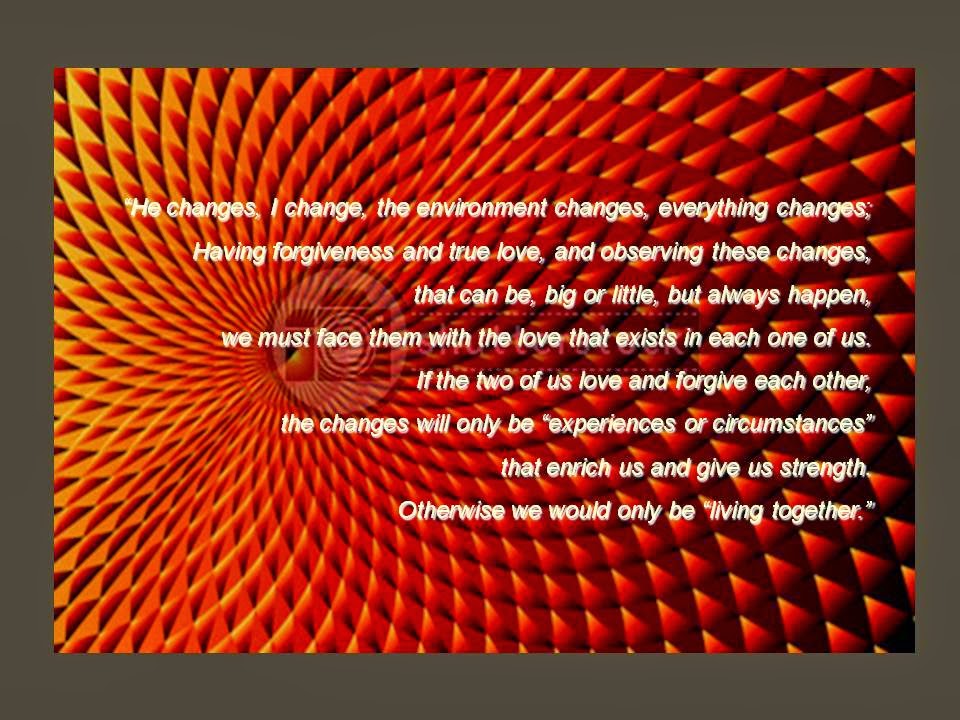
For a long time I did not hear from her. Then one day about a year on, I received a mail from her - just 2 lines. She said Ajay I am very happy and joyful now thank you. Ajay I would have said thank you for all you did for me to make me joyful, but I have learnt my lessons well: So I just say “Thank you” because now I know that no one can “Make” me Joyful and Happy “I am Joyful”. She had also attached a small presentation for me, of her “Enlightenment” which I now bring to you. She put it up on the net, so many of you might have read it. Originally it was written in Spanish, I post the translated to English version. I hope that all my friends who read this blog will attain Joyfulness as my Mexican friend did. I feel that nothing matters more in life than being “Joyful within ourselves” at all times. 

The presentation is no longer available to embed so I have uploaded all slides to be seen serially.
Ajay


Saturday, 9 February 2013

TET GREETINGS FOR ALL MY VIETNAMESE FRIENDS


To All My Dearest Vietnamese Friends:

I wish all of you a very enjoyable TET Season and a Very 


Happy New Year. 

I pray that the Lunar Year Chun Jie / 春节 2013 fulfill all 

your wishes, Dreams and Aspirations.

CHÚC MỪNG TẾT... 

Be happy my friends :) :)


Thursday, 7 February 2013

TRAVEL AND HOLIDAY : NAIROBI NATIONAL PARK

Nairobi National Park.
After having been to most of the major wild life reserves of Kenya, I suddenly realized that it is nearing our departure time to India and I have not been to The Nairobi National Park, proverbially sitting right in our backyard. Truthfully the gate of the NP is just a couple of kilometers or so from where I am staying with my daughter in Nairobi. 
So last Sunday my son in law Sandeep and my grandson Anudeep decided to set out on an "All Boys” expedition to NP as Anudeep puts it. We decided to use our own car and no Safari vehicle. Though we did hear comments “Waste of time”, “One never sees anything” and similar gibes. 

Nairobi National Park is unique by being the only protected area in the world with a variety of animals and birds close to a very large city. It is located approximately 7 kilometres south of the centre of Nairobi, Kenya's capital city, with only a fence separating the park's wildlife from the metropolis. Nairobi's skyscrapers can be seen from the park.

Nairobi National Park was the first national park established in Kenya. The park covers an area of 117.21 square kilometres (28,963 acres) and is small in comparison to most of Africa's national parks. The park's altitude ranges between 5,000 ft and 6000 ft. It has a dry climate. The park is the only protected part of the Athi-Kapiti ecosystem. It has a diversity of environments with characteristic fauna and flora. Open grass plains with scattered acacia bush are predominant. 

The western side has a highland dry forest and a permanent river with a riverine forest in the south. In addition, there are stretches of broken bush country and deep, rocky valleys and gorges with scrub and long grass. Man-made dams also attract water dependent herbivores during the dry season.
The park has a rich/diverse birdlife with 400 species recorded. However all species are not always present and some are seasonal. Northern migrants pass through the park primarily during late March through April. To the south of the park is the Athi-Kapiti Plain and Kitengela Migration and dispersal area. These are vital areas for herbivores to disperse during the rains, so also to concentrate in summers. All in all it is an amazing experience.
Imagine a huge zoo in your city of some 120 square kilometers, where all the animals run free and which you can visit every week end. 
Since we had no expectations we were extremely delighted and happy when we chanced to spot just one solitary deer during the first hour of our sojourn. The day turned out good for the three of us. I have put up a few pictures of what we saw. Please bear with the quality of the pictures as they are highly compressed during conversions.